|
March | 2026 |
| |
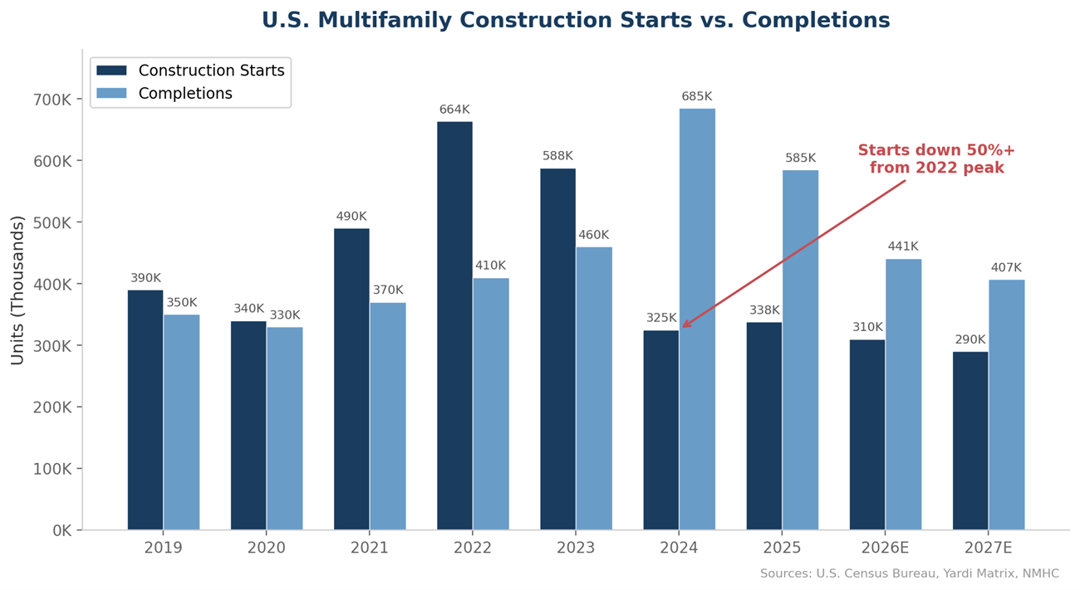
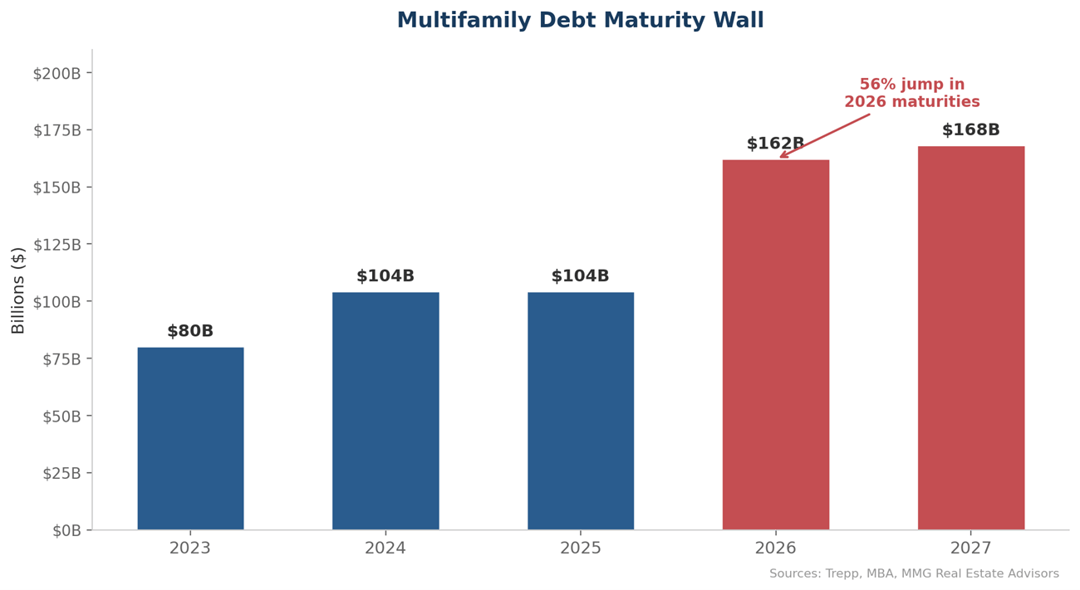
| Navigating the Current Multifamily Landscape As we reach the end of Q1, we wanted to update our clients and partners on what we're seeing at the macro level, current property operations, and the current acquisition landscape. After absorbing the largest multifamily supply wave in 50 years, the construction pipeline has collapsed to its lowest level in over a decade. Nationwide, construction starts fell 17% in 2025 and with Q4 hitting the weakest quarterly pace since 2012.1 At the same time, over $160 billion in multifamily debt is maturing in 2026 alone, forcing overleveraged owners to recapitalize or sell at reset pricing.2 The result is a widening pool of acquisition opportunities at bases well below replacement cost. Our conviction: as the current supply surplus is absorbed over the next 18-24 months, we believe fundamentals will normalize and the 2026-2027 acquisition vintage will prove to be a compelling entry point. | |
| 1 NMHC Market Trends, February 2026 2 Trepp: Moody's CRE | Interest Rates & Lending Landscape On January 30, Trump nominated Kevin Warsh to succeed Powell in May. Warsh has long opposed quantitative easing and advocates "supply-side" monetary policy: lower rates to spur productivity, paired with a leaner Fed balance sheet. In a November 2025 WSJ editorial, he argued AI-driven productivity enables rate cuts without reigniting inflation.3 Aligned with Warsh's objective, the Fed's December projections indicated one more cut in 2026 and one in 2027.4 Despite global uncertainty around Treasury demand, multifamily borrowing costs fell ~50 bps in late 2025 vs. prior year.5 The Federal Housing Finance Agency (FHFA) increased Fannie Mae and Freddie Mac lending caps to $176B combined for 2026, improving sector liquidity.6 Why This Matters for Investors: We continue to monitor changes in the Fed's fiscal policy, but we are not in the business of predicting interest rates. With only one additional cut projected in 2026, we expect minimal movement in both interest rates and cap rates this year. We continue to conservatively underwrite assets to current rates where we can deploy our value-add business plans as key drivers of upside. Any decrease in interest rates should improve returns on exit. Additionally, the $176B in agency capacity reinforces liquidity in our preferred debt channels as we actively deploy into the current environment. We are evaluating refinances where appropriate across our portfolio. | 3 Wall Street Journal, November 2025 4 Federal Reserve, December 2025 Summary of Economic Projections 5 NMHC Market Trends, February 2026 6 FHFA, 2026 Lending Caps Announcement | The Current Transaction Market and The Road to 2027 In Q4 2025 apartment sales hit $41.4B, the highest quarterly volume since Q3 2022, and CBRE projects another ~16% increase in 2026.7 Acquisition activity is picking up, but cap rates in the mid-5% to low-6% range and negative leverage continue to keep many buyers on the sidelines. The market is transacting, just selectively. An estimated $400B in prior-year maturities were rolled via modifications, but lenders are now forcing resolution on 2021-2022 vintage loans.8 Multifamily maturities will jump 56% to ~$162B in 2026 and $168B in 2027.9 Many loans that were originated at 3-4% now face nearly double what they were. | |
| Why This Matters for Investors: While Q4 2025 experienced the highest quarterly volume since Q3 2022, transaction volume is still down off prior peaks. However, this landscape also has its advantages. Fewer active buyers mean less competition for current market opportunities. Over the past 24 months BCE has acquired 11 assets at up to 35% below peak valuation totaling $625m of gross real estate. This demonstrates our ability to source and close attractive opportunities in this environment. Our broker relationships and operating partner network give us access to off-market opportunities before they hit the broader market, allowing us to move with conviction while others wait for clarity. BCE continues to target dislocations, recapitalizations, and distressed bases with built-in margin of safety. 7 CoStar: CBRE 2026 Market Outlook 8 S&P Global: Moody's CRE 9 Trepp: Mortgage Bankers Association | Operations: Protecting Value in a High-Cost Environment While we continue to deploy capital into attractive opportunities, operational execution and expense management remain key value drivers across the portfolio. Our current portfolio-wide occupancy sits at 93.5%, which includes assets actively undergoing renovation, a strong indicator of demand even during business plan execution. Nationwide, unleveraged apartment returns hit 5.3% in 2025, outperforming every other major property type.10 Per-unit expenses across the sector reached $8,694/year, growing 9.3% in 12 months, with insurance being the biggest driver.11 Premiums rose 75% from 2019-2024, though they have come off their 2023 peak.12 In 2020, we moved away from our master insurance program and shifted to highly rated regional carriers by market, a decision that insulated our portfolio from the steep premium increases many consolidated programs faced from 2021-2023. Today, our in-force premiums run 10-15% below market in the Southwest and 20-30% below market in California, and our scale with these carriers gives us preferred access to coverage on older vintage assets that many insurers will no longer quote. We continue to monitor the market to ensure we are positioned to pivot back to a master program when conditions warrant. Additionally, utility retrofits and management software are implemented across our portfolio. Rising home prices and mortgage costs are keeping people in the renter pool longer, which is a tailwind for occupancy but also increases the need to screen tenants efficiently.13 Higher turnover drives bad debt and creates operational stress at the property level. Our portfolio and asset management teams use two layers of screening through RealPage and Verifast to verify tenant credit scores, income, I.D., and reduce bad debt from the start. Why This Matters for Investors: The money we save on expenses directly impacts net operating income. Year to date, NOI is up 3.6% on average YOY across our portfolio, driven by revenue growth of 4.5%, even as the broader market has experienced flat to negative rent growth. As markets continue to improve, every dollar of NOI we've protected is worth more. BCE's portfolio and asset management teams continue to deliver diligent operational and expense management across insurance, utilities, and bad debt. | 10 NCREIF 11 Yardi Matrix 12 Federal Reserve Board 13 CBRE 2026 Market Outlook | Coastal Resilience & Contrarian Growth Coastal markets continue to demonstrate attractive metrics regarding a lack of new supply and current rent growth. Nationally, only 12.7% of renters can afford a median-priced home; in Santa Clara County, mortgage payments are 3.3x rent.14 San Jose's 2026 delivery pipeline is ~10% of 2025 levels and San Francisco led the nation in rent growth last year.15 Limited land and strict zoning keep new competition minimal in these coastal markets. Orange County's construction pipeline represents just 1.9% of existing inventory, less than half the national average.16 In Seattle, the construction pipeline is at its lowest level in a decade, down from ~29,000 units at peak to 15,400. Occupancy at 94.4% with 80% of Washington households priced out of ownership.17 Growth markets like Denver and Phoenix tell a different story. 34,000 units were delivered in 2024 across both metros, but completions are forecast to fall ~50% and ~34% respectively in 2026.18 Absorption is running at 2x the 10-year average and vacancy ended 2025 at 7.5%, 50 bps below earlier forecasts.19 We continue to target workforce housing across vintages at compelling discounts to replacement cost in these markets. Why This Matters for Investors: We continue to approach our markets opportunistically. In Coastal markets (Bay Area, Orange County, Seattle), we are buying into the widest affordability gap in history and in supply-constrained submarkets. In growth markets like Phoenix and Denver, we take the other side of the consensus, have been targeting 1990s and 2000s vintage at a lower basis while absorption outpaces new supply and the construction pipeline collapses. | 14 CBRE 2026 Market Outlook 15 CoStar 16 Northmarq 17 CoStar; Washington State Housing Finance Commission 18 Marcus & Millichap; Northmarq 19 MMG Real Estate Advisors | Conclusion The multifamily market is near the end of the largest supply correction in half a century. New multifamily developments that started in 2021 and 2022 are currently being delivered and absorbed. Little new delivery broke ground in 2023 through 2025, which means the delivery pipeline should dry up by 2027 through 2028. We believe supply and demand fundamentals will moderate meaningfully over the next 18 to 24 months. As the supply surplus is absorbed, vacancy should compress, concessions should burn off and rent growth should reaccelerate. Population growth, job creation, and the housing affordability constraints indicate that demand remains resilient. As rent growth returns and disciplined expense management continues to protect NOI, asset values should improve further as cap rates compress. |
|
Jim Rosten Co-Founding Principal
|
Nicholas Matus President & Chief Operating Officer
|
Ryan Somers Chief Investment Officer, Capital Markets
|
| |
| |
|
89 Properties
|
19,205 Residential Units
|
$5B AUM
|
As of 6/30/25 | |
| www.bceproperties.com | Benedict Canyon Equities, Inc. 10100 Santa Monica Blvd., Suite 420, Los Angeles, California, 90067
Unsubscribe
Manage Preferences |
|